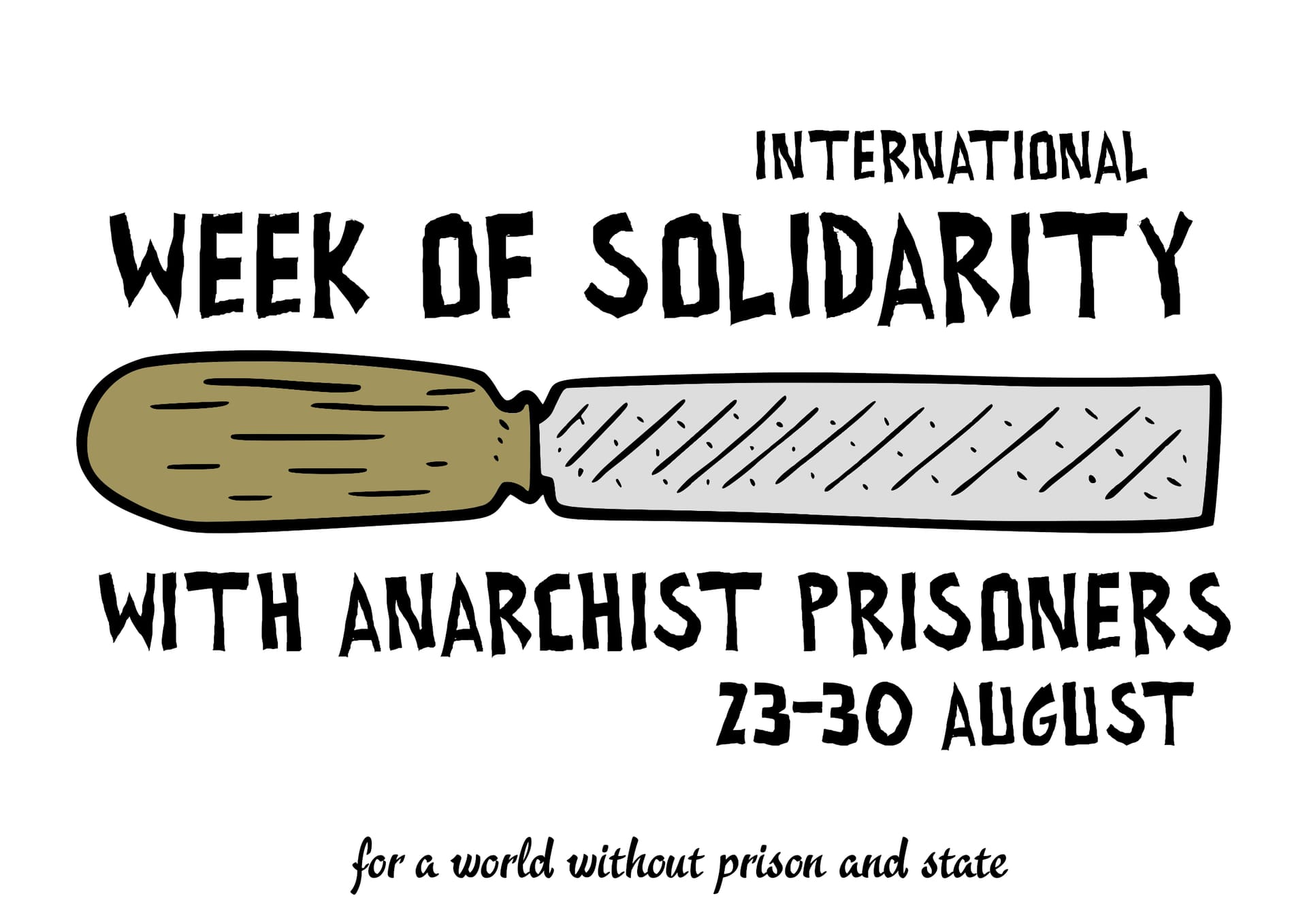
People from Potsdam (Germany)sent us this article about remembrance culture :
The “Week of Solidarity with Anarchist Prisoners” (WOSWAP) is taking place once again, as always from August 23 to 30. This international campaign with the unwieldy title dates back to 2013. It was launched by the Anarchist Black Cross.
In summer 2013 members of several Anarchist Black Cross groups discussed the necessity of introducing an International Day for Anarchist Prisoners. Given there are already established dates for Political Prisoners Rights Day or Prison Justice Day, we found it important to emphasise the stories of our comrades as well. Many imprisoned anarchists will never be acknowledged as ‘political prisoners’ by formal human-rights organisations, because their sense of social justice is strictly limited to the capitalist laws which are designed to defend the State and prevent any real social change. At the same time, even within our individual communities, we know so little about the repression that exists in other countries, to say nothing of the names and cases involving many of our incarcerated comrades.
Anarchists around the world have been responding to this call for 12 years now. The website’s archive (https://solidarity.international/) contains a collection of past posts from various countries. The forms of action that the groups come up with are also diverse. The Solidarity Week often features relevant film screenings or rallies in front of courthouses and prisons, as well as photos with solidarity banners and graffiti. The focus, of course, is on establishing contact with anarchist prisoners by writing letters. Every year, WOSWAP publishes an updated list of anarchist prisoners, which includes their names, the reasons for their imprisonment and the length of their sentences, the prisons where they are being held, and the corresponding addresses. The website also provides helpful tips and answers to legal questions, because even though prisons (in Germany) allow letters to be received, you should expect the contents to be inspected, and the privacy of correspondence may be compromised.
These obstacles must be overcome, because these letters and the exchange with the outside world make a huge difference for people behind bars. What you write doesn’t have to be highly complex—that just overwhelms everyone. Stories from your own daily life and simple information about yourself can already help maintain a sense of connection to the world outside the walls. It’s important to indicate your own availability to write. Are you making an effort to maintain regular written contact? Or are these one-time gestures of solidarity? It’s highly recommended to include stamps (check with the prison regarding the allowed number), since inmates would otherwise have to pay for them themselves.
Writing letters to political prisoners—in this case, anarchists—is a very meaningful practice. Not only does it make time in prison more bearable, but it also shows that solidarity doesn’t end at the prison walls. The very concept of punishment is fundamentally flawed; it is an expression of incompetence, a declaration of societal bankruptcy. Through displays of power and deterrence, it masks its own inability to cope. When the state punishes and “deprives” people of their freedom for several years, it is an act of revenge motivated by a sense of moral superiority. But our imprisoned comrades do not have to cope with this alone, and it also gives them a certain sense of safety to know that human connection does not cease to exist just because prison walls separate us. Making full use of this possibility within the anarchist movement should become even more self-evident and, above all, put into practice. It’s worth encouraging one another to start writing letters. This builds trust and confidence before we ourselves are arrested and have to rely on others to reach out to us.
(…) It is the anarchist prisoners who remind us that repression is always political as well. Those who fundamentally challenge authority feel the power of the state in a particularly forceful way.
This makes practical solidarity all the more important: postcards and letters are a first step. They let prisoners know that people are thinking of them, that they are not forgotten. For me, the many letters I received, as well as the exchange of ideas through correspondence—even though it was strictly monitored by the prison—helped me survive. In some cases, friendships even developed from this that still endure today.
The International Week of Solidarity reminds us that together we defend freedom—for and with the people behind bars. It is our solidarity that breaks through the isolation.
That is why the International Week of Solidarity with Anarchist Prisoners is much more than a gesture toward individuals. It is a reminder that freedom is indivisible. That walls do not only surround prisons. After nearly three decades in prison, I have experienced how deeply the outer walls have penetrated me, both mentally and physically. Freeing oneself from this afterward is a lengthy process—yet it is more likely to succeed in an environment of solidarity than in the cold of solitude.
The walls won’t disappear tomorrow or the day after tomorrow; the International Week of Solidarity will likely continue for many years to come. To some people, the impact of such a solidarity week may seem small. But without that small contribution, everything will remain as it is.
This excerpt is from Thomas Meyer-Falk, who was released in 2023 after 27 years in prison and shared his thoughts on prison solidarity for this year’s Solidarity Week. Solidarity Week with Anarchist Prisoners is therefore the perfect opportunity for all groups that want to give this issue the attention it deserves.
Groups from Potsdam have also been participating in WOSWAP for several years; for example, the Korean film “Anarchist from Colony” was screened in 2023. It is a historical drama about the anarchists Kaneko Fumiko and Pak Yol. In the early 20th century, when Korea was occupied by the Japanese Empire, the two meet, fall in love, and plan an assassination attempt on the Japanese Crown Prince Hirohito. When an earthquake strikes the Kanto region, the Japanese government stirs up anti-Korean sentiment, claiming that Koreans are setting buildings on fire and poisoning wells. As a result, reactionaries hunt down anyone they deem non-Japanese. Over 6,000 Koreans are murdered in a racist massacre. Anarchist and socialist groups also find themselves in the crosshairs, and Fumiko Kaneko and Pak Yol are arrested and brought to trial.
The anarchist couple is using the trial as a public platform to draw attention to Massker, and the international press is reporting on it. A few days before the judge handed down the verdict, the defendants got married. To Fumiko Kaneko, this seemed unusual; officially, she had never been closely associated with the feminist movement of the time, yet she vehemently criticized societal sexism. She refused to submit to the “role” assigned to her as a woman, never wanted to be subordinate to a man, and also denounced gender hierarchies within socialist groups. This decision can be interpreted as an ironic performance. The newlyweds, married under the Japanese Empire, faced the death penalty from that very institution—whether in life or in death, their bodies belonged to the imperial power. In the film adaptation, the marriage is further justified by the possibility that, despite being separated during their imprisonment, Kaneko Fumiko and Pak Yol would have to be buried together as a married couple following their execution. However, the execution is prevented, and an imperial pardon “reduces” the sentence to life imprisonment. For Fumiko Kaneko, this was a shattering turn of events; she viewed it as a hypocritical gesture of goodwill, a perfidious act of self-aggrandizement on the part of the emperor. After the end of World War II and the defeat of the Axis powers, Pak Yol was liberated by the Allies, but his wife had died while in prison. Officially, the cause of death was listed as suicide. Her closest confidants doubted this explanation and suspected murder, arguing that the circumstances were too suspicious. Suicide, however, would also be consistent with Kaneko Fumiko’s rebellious nature, as a means of reclaiming her autonomy. Her memoirs, which she wrote while still in prison, were published posthumously. Translated into English, the work is titled “The Prison Memoirs of a Japanese Woman.” Her date of death is recorded as July 23, 1926—coincidentally, exactly one month and one year before the execution of the Italian anarchists Nicola Sacco and Bartolomeo Vanzetti.
On August 23, 1927, Sacco and Vanzetti were murdered by the U.S. justice system in Charlestown, Massachusetts, on the electric chair. Presumably, the starting point of the Week of Solidarity with Anarchist Prisoners draws on the widespread recognition of this case. By 1971 at the latest, with the release of the film “Sacco e Vanzetti” (which is also frequently screened during WOSWAP), this pivotal event in anarchist history regained popularity. The soundtrack—and in particular the song “Here’s to You” featured on it—likely played a major role in this resurgence. While Ennio Morricone composed the melancholic melody, which is catchy and stays with you, Joan Baez wrote and sang the memorable yet powerful lyrics.
Here’s to you, Nicola and Bart
Rest forever here in our hearts
The last and final moment is yours
That agony is your triumph
Four simple lines, Joan Baez’s powerful voice, and an unmistakable melody make this song an anthem of anarchism and a global hit of the ’70s. Furthermore, this tribute has found its way into pop culture. The video game series *Metal Gear Solid* had a cover version recorded specifically for the game, and singer-songwriter Franz Josef Degenhardt sang a German interpretation that included a fifth line. But particularly beautiful is the example of the East German punk band “Der Schwarze Kanal,” which incorporates the distinctive melody into their riffs to place the concept of direct action at the center of their tribute.
It is fascinating to see the contribution that artistic interpretations can make to anarchist commemorative culture. Before their trial, Nicola Sacco and Bartolomeo Vanzetti were not the most prominent figures in anarchism. The two conscientious objectors were active in the labor movement and, as Italian immigrants, fell victim to the racist arbitrariness of the U.S. justice system. Convicted of a crime that could not be proven against them, they were sentenced to die in the electric chair. At the time, this sparked a wave of outrage and led to mass demonstrations around the world. A hundred years have passed, and these two ordinary anarchists are still commemorated in film, music, and poetry. In the town of Birkenwerder in northern Brandenburg—probably the only place in Germany—there is even a street named after Sacco and Vanzetti.
Also noteworthy is “La ballata del Pinelli,” a musical piece that poignantly chronicles the tragic death of Giuseppe “Pino” Pinelli. During a police interrogation in Milan in 1969, the anarchist and secretary of the Italian section of the Anarchist Black Cross fell from the fourth floor of the police building. He was suspected of a bomb attack that, as it later turned out, had been carried out by the neo-fascist group “Ordine Nuovo.” The three police officers who had illegally interrogated him for three days without a court order were charged with murder but acquitted due to lack of evidence. The official explanation for his death is still rightly questioned today, and it is believed that the police officers pushed Pinelli out of the open window during the interrogation. Inspired by this event, the play “The Accidental Death of an Anarchist” was written, and in honor of Pinelli, the artist Enrico Baj created the installation “The Funeral of the Anarchist Pinelli.” Artistic tributes like these keep the memory of our comrades alive.
Therein lies a power that we, as anarchists, can unleash: a culture of solidarity and remembrance from below, in which no one is forgotten—least of all the anarchist prisoners who will be the focus of our attention from August 23 to 30.
Let’s join the Week of Solidarity with Anarchist Prisoners, develop pen-pal relationships, and encourage our comrades to do the same. Let’s get creative—draw comics, write poems, stage plays—so that future generations can learn about our struggle and the injustice our imprisoned siblings have to endure behind bars. This message can also be taken directly to the streets through rallies and demonstrations—ideally right in front of the prison. Film nights are another low-barrier way to get involved; there’s plenty of relevant material available, and they encourage direct discussion about past and present cases and what kind of support is needed. The Pirata Wars Potsdam also take place every year in late August. During the day, there’s pirate fun and “naval battles” with homemade boats on the Havel River, and in the evenings, concerts—last year, these raised money for the Anarchist Black Cross Berlin. Actions against repression and in support of prisoners can take many forms; they can be direct or indirect, combined with fun, or maintain the necessary seriousness. Let’s make use of the opportunities we have, whether they’re big or small; in the end, what counts is the collective impact and the ray of hope we shine on anarchist prisoners.
If you or your group are planning an event for the Week of Solidarity with Anarchist Prisoners, or if you have a solidarity photo you’d like to share, please send an email to: tillallarefree(at)riseup.net. And if it doesn’t work out this year, there will certainly be another opportunity in the future. Unfortunately, the current system of oppression still exists, and the repression and criminalization of anarchists are only increasing.
Class-based justice and racist conditions will intensify, and prisons will become more crowded. But no matter which government is in power, the massive expansion of surveillance and control is already in full swing among the “democratic” parties. We don’t have to wait for things to get worse—they’ve always been bad. Our comrades were imprisoned more than ten years ago. How do we want to organize ourselves now, and what are our hopes for the future? We have nothing to expect from the ruling system, the political parties, or Parliament. We can rely only on ourselves to build a more just, non-hierarchical world together with our fellow human beings—and until then, the motto remains: No one is free until all are free!